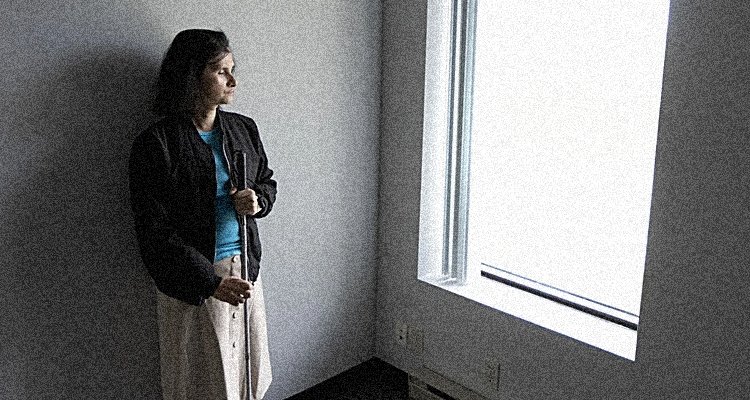
Passing the bar exam would be tough not only for the usual reasons but also because Joy Luk is blind.
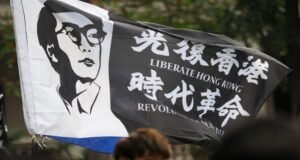
National Post reports that Luk (shown above) “is grateful for the welcome she received in Canada—but dismayed by Ottawa’s push to improve relations with China.” She was among the many who participated in Hong Kong’s massive pro-democracy protests of 2019. It’s not an experience that she has been able to put behind her (October 16, 2026).
Luk says she has nightmares about being struck by police and is startled by a knock at her apartment door, a reminder of the visits to her home from belligerent officers amid a Chinese-government-backed crackdown on opposition.
But the spirit behind her extraordinary role in the Hong Kong protests hasn’t dimmed, even as she’s treated for post-traumatic stress disorder.
The 47-year-old has spoken at vigils here commemorating the anniversary of the Tiananmen Square massacre, given talks on the “criminalization” of dissent and picketed outside China’s Toronto consulate.
A ceremony on Monday, though, will mark what might be Luk’s most impressive accomplishment since arriving in Canada. After obtaining a Global Professional Master of Laws degree at the University of Toronto and passing bar-admission exams made all the more challenging by her lack of sight, she’ll be officially admitted to the profession in Ontario.
She attributes the bravery that other protesters saw in her in Hong Kong to her inability to see.
“If you see the police, they are running toward you, your direct reaction is to leave. But I could not see.”
Luk became a well-known figure in the movement, a blind woman seemingly fearless in the face of aggressive police tactics, says Cheuk Kwan of the Toronto Association for Democracy in China.
“She stood out,” says Kwan. “Despite all the oppression and suppression by the police, she was willing to stand up front and be counted.”
Perhaps the challenges Luk has faced in Canada, to which she emigrated in 2021, have not loomed as large in comparison. “In the very beginning, when I arrived in Canada, I didn’t think I could be a lawyer again,” she tells the Post. But inspired by the Steve Jobs dictum “I accept failure, but I do not accept not trying”—and reasoning that “The worst case is I would not pass”—she passed the exam on her first try.
The exams were lengthy and to complete them she had to have her computer convert the text to speech, to the point where she began dreaming of the electronic voice. The computer can also convert text to braille, but that’s a much more time-consuming process.
A particular challenge were exam questions that required looking at an image, such as a land-titles document.
“I had to ask A.I., ‘Using a blind person’s perspective, describe this picture, this figure, to me and let me know what it’s showing.”
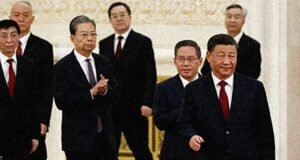
About Prime Minister Mark Carney’s push to improve trade relations with the People’s Republic of China, she comments: “I guess they are not eager to fight for freedom of the people in Hong Kong and other parts of China under that kind of tyranny. Because they want to sell some things to China. We are very disappointed by this.”