The word “corruption” performs at least double duty in the Chinese Communist Party. It can mean willingness to take bribes and kickbacks—graft. It can also mean less than perfect loyalty and obedience to the Party and/or the big boss loyalty to whom is equated with loyalty to the Party.
Graft is common in the CCP. It can be called a form of disloyalty, one that Xi Jinping may target whenever convenient. It probably would not be convenient to charge all top officials in the Chinese Communist Party or People’s Liberation Army with graft simultaneously. But “corruption” can also refer to forms of disloyalty unrelated to graft.
Kitchen sink
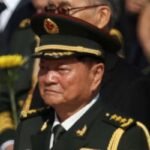
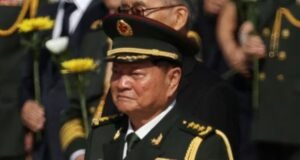
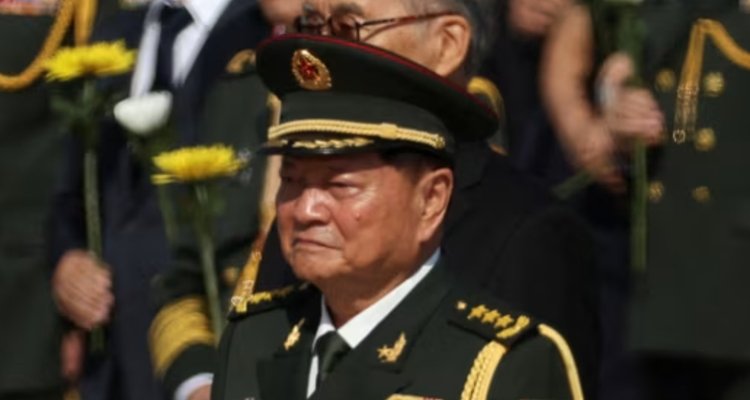
Which kind of corruption are Zhang Youxia (shown above) and Liu Zhenli being accused of? Or is it both? The headline of one recent report says “China expels generals accused of graft from Communist Party” and explains that “The announcement fit into the sweeping anti-corruption drive that has defined President Xi Jinping’s time in power” (Agence France-Presse, September 21, 2026).
Then: “An investigation found Zhang and Liu had ‘become disloyal to the Party…and crossed red lines’ by committing offenses including forming cliques and accepting huge sums of money for personal gain, Xinhua said.”
Al Jazeera’s headline says “China expels two top ‘disloyal’ military leaders from Communist Party.” And the subhead distinguishes between corruption and disloyalty: “China removes two top generals over corruption, disloyalty as part of an ongoing anti-corruption crackdown.”
The expulsions are part of the president’s sweeping anti-corruption crackdown, with thousands of officials being purged and millions within the Chinese bureaucracy investigated. The campaign is among the largest in modern Chinese history, including prior removals of high-profile political rivals.
According to an article relying on AFP and Reuters:
The Chinese leadership accused Mr Zhang and Mr Liu of disloyalty, corruption, dereliction of duty and other serious disciplinary violations.
An investigation found Mr Zhang and Mr Liu had “become disloyal to the Party…and crossed red lines” by engaging in a list of offences including forming cliques and factions, adding that their “political and economic wrongdoing were intertwined, and corrupt self-enrichment coexisted with dereliction of duty and abuse of office”.
“The sums involved were exceptionally large; the nature (of their conduct) was extremely serious and the impact extremely egregious,” Xinhua said.
The two men also “used their positions to help others in matters such as job promotion”, according to the reports, and their expulsion would be subject to ratification at a plenary session of the Party’s Central Committee.
Last month, Mr Zhang and Mr Liu were stripped of their positions in the state CMC [Central Military Commission].
So it’s the kitchen sink being thrown at them. At this level of generality, many of the same things were being said months ago, before the outcome of any further investigation. According to a PLA Daily editorial published at the time, Zhang and Liu were guilty of “seriously trampling on and undermining the system of ultimate responsibility resting with the CMC chairman”: opposing Xi.
One accusation lobbed against Zhang soon after his arrest in January, that he had been guilty of handing China’s nuclear secrets to the United States, apparently expired within nanoseconds of being relayed by The Wall Street Journal. A day after the Journal published its January 25, 2026 story, Defence Talks was saying that “Serious Questions Surround” the report and suggesting that the CCP had floated “exaggerated or unverified claims” solely in order to rationalize so serious and shocking a move as acting to topple Zhang. Others echoed these doubts. Xi and his gang must have realized that minus any evidence, so improbable a charge would not help their cause. In any case, that particular charge never showed up in official CCP outlets.
Behind the scenes
China watchers had been speculating for months about a power struggle going on between Zhang Youxia and Xi Jinping before Xi acted to take down Zhang, and, incidentally, Liu. Many, including Lei of Lei’s Real Talk, thought that Zhang and his supporters might act to remove Xi from power. Their hopes would be dashed.
General Zhang was powerful and well-liked enough that, even after he had been arrested in January 2026, it was impractical for Xi eject him from all of his posts immediately. Having ruffled a lot of feathers, Xi had to wait for things to settle down a bit. So only now, nine months later, is Zhang losing his membership in the Chinese Communist Party.
Also see:
Lei’s Real Talk: “Could Xi Jinping Use a Taiwan Crisis to Stay in Power?” (September 8, 2026)
StoptheCCP.org: “Everything We Don’t Know About Fourth Plenum and Fate of Xi Jinping” (October 26, 2025)
StoptheCCP.org: “China’s Corruption and Anti-Corruption Are Forever” (November 2, 2024)