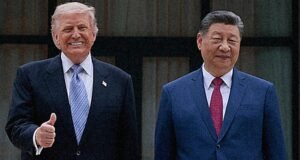
About a week ago, the story was that U.S. President Donald Trump “trusts” the Russian and Chinese governments “not to enable Iran,” repeating sentiments he has uttered before.
“President Xi, at our recent meeting in Beijing, China, told me that he would not, under any circumstances, give or sell Weapons to the Islamic Republic of Iran. And that statement included Chinese Companies,” Trump typed on Truth Social. He said he’d gotten a similar assurance from Vladimir Putin.
He also said, “I don’t know that they’re enabling [Iran]. I think I trust them.” A ringing endorsement.
Mizar Vision
This blarney had by then already been multifariously contradicted; for example, by the prolific willingness of Chinese companies like Mizar Vision to provide Iran with satellite images to improve targeting. Mizar Vision has posted many highly militarily relevant high-resolution images online; one of its releases “catalogued approximately 2,500 individual US military assets across the [Middle East] region.” The U.S. has sanctioned several Chinese companies for providing the images.
China has reportedly also shipped weapons components and fuel to Iran. And Russia is thought to be providing Iran with intelligence and drone technology.
To this assistance must be added all the weapons, tanks, aircraft, submarines, missiles, fuel or fuel components, production technology, etc. that China and Russia have given to Iran in the years and decades before the current war. China and Russia are simply continuing old habits.
According to reporting in May 2026, President Trump had already by then, per a senior administration official, “spoken ‘multiple times’ with Xi about ‘the revenue that China provides to both those regimes [Iran and Russia]…as well as dual-use goods, components and parts, not to mention the potential of weapons exports.’ ”
Shoulder-fired
And now Iran is “set to receive up to 400 Chinese shoulder-fired air-defense systems within weeks” (The Times of Israel, July 29, 2026).
The purchase, valued at $60-70 million, is one of Tehran’s largest-known efforts to strengthen its short-range air defenses since the outbreak of its war with the US and Israel in late February, which exposed gaps in Iran’s ability to protect military sites and strategic infrastructure.
This delivery would significantly expand Iran’s inventory of short-range air-defense weapons and suggest deepening military ties with China.
The deal was signed with Zhongqing Baoshang International Investment, a Hong Kong-based company that the sources said was acting as an intermediary between the Iranian side and the Chinese supplier.
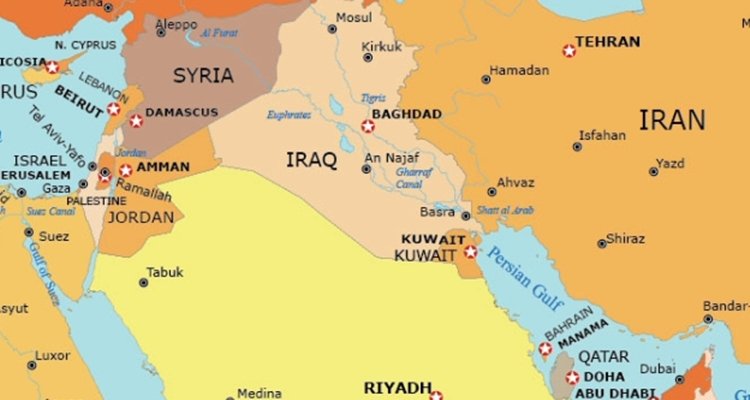
Under a plan agreed to by the parties, deliveries will initially be by air from Urumqi in western China, then transiting through Pakistan to Iran, according to the sources, who did not clarify whether the transfers would take place by air or by road….
While Iran has invested heavily in the past two decades in missiles, drones and radar, military experts say portable air-defense systems are important because they can be dispersed quickly, operated by small teams and relocated frequently, making them less vulnerable than fixed air-defense batteries.
Perhaps Trump can ask Xi Jinping to tell Mizar Vision to post high-resolution imagery of the route from Urumqi to Pakistan to Iran along which the 400 shoulder-fired air-defense systems will be traveling so that the U.S. can find a way to seize or destroy them.