The 2020 U.S. emergency declaration on Hong Kong, which imposed sanctions on various Hong Kong officials and canceled preferential trade treatment for Hong Kong, was recently allowed to lapse.
The reason, Secretary of State Marco Rubio has “explained,” is that in the president’s view circumstances have changed. This Q&A is from a press briefing posted July 24 on the U.S. Mission China website:
QUESTION: Yes, what prompted the easing of sanctions on Hong Kong last week in terms of letting the executive order expire on lifting sanctions—
SECRETARY RUBIO: Yeah—no, it wasn’t easing of sanctions. The executive order expired. [This characterization is disingenuous. The order did expire—because it was not renewed, as it had been by the Biden administration in 2021, 2022, 2023, and 2024 and by the Trump administration in 2025.] The conditions underlying some of those elements no longer existed. But there remain other individuals that remain sanctioned nonetheless, despite—the executive order is a partial expiration on certain individuals, but not on others. It just depends on the light of it. And the justification and rationale behind that original executive order had sort of—the circumstances had changed in the President’s judgment.
Despite the lapse of the emergency declaration, Hong Kong’s pre-2020 preferential status with respect to matters like trade and export controls has not been restored.
Although a “significant number of individuals remain sanctioned,” some Hong Kong officials subjected to sanctions by the 2020 emergency order, including officials currently holding office in Hong Kong, are no longer subject to any U.S. sanctions. What change in “underlying conditions” is Rubio talking about that justifies this?
De-sanctioned
South China Morning Post reports that under the 2020 order, “the United States imposed six rounds of sanctions targeting 48 Hong Kong and mainland officials between 2020 and 2025. Following the expiry of the declaration, sanctions were removed on nine Hong Kong and mainland officials, including Secretary for Justice Paul Lam Ting-kwok, Dong Jingwei, director of Beijing’s Office for Safeguarding National Security in Hong Kong, and two former police commissioners, Raymond Siu Chak-yee and Stephen Lo Wai-chung.”
The other five who received complete sanctions relief are Sonny Au Chi-kwong, Dick Wong Chung-chun, Margaret Chiu Wing-lan, Qiu Hong, and Yang Jianping.
The Committee for Freedom in Hong Kong (CFHK) Foundation reports that “The sanctions imposed on the 9 [persons who are no longer sanctioned] were solely based on E.O. 13936/IEEPA [International Emergency Economic Powers Act], which expired on July 17, 2026…. For the 39 people who were separately identified in a State Department report to Congress under HKAA [Hong Kong Autonomy Act] Section 5(a), a parallel statutory sanctions obligation persisted….
“The 9 fully unblocked individuals include five officials who still currently hold office within China’s national security apparatus on Hong Kong. [It seems that one of these five identified by CFHK, Qiu Hong, is no longer working in Hong Kong.] Paul Lam, the current Secretary for Justice, oversees prosecutions under Hong Kong’s National Security Law.”
CFHK concludes that the U.S. government’s action “went beyond eliminating duplicative sanctions. Nine officials received complete sanctions relief, while the transfer of the remaining 39 off the Specially Designated Nationals and Blocked Persons (SDN) List weakened the practical visibility and deterrent effect of the sanctions against them.” That’s because the Non-SDN Menu-Based Sanctions (NS-MBS) list containing these 39 names has “fewer compliance requirements and is often not screened by financial institutions, effectively easing these individuals’ access to financial services.”
The Foundation recommends that the Trump administration “immediately reimpose sanctions on the nine officials, as well as other individuals who continue to participate in the crackdown, using all applicable authorities under the Hong Kong Human Rights and Democracy Act and the HKAA.”
Still in power
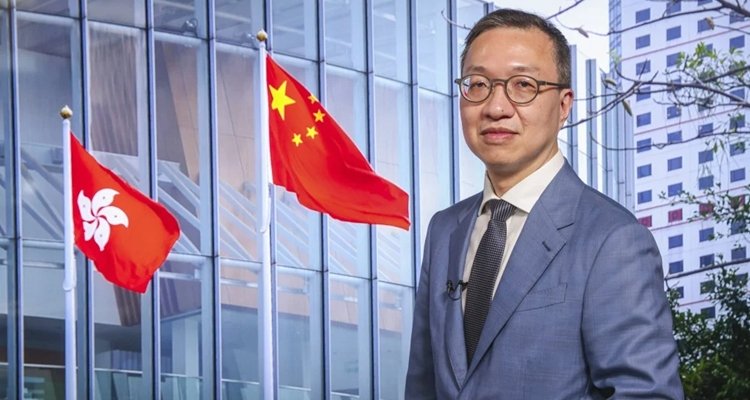
Four of the nine who received “complete sanctions relief” are currently holding office in Hong Kong: Dong Jingwei, director, Office for Safeguarding National Security; Dick Wong Chung-chun, assistant commissioner, Hong Kong Police Force, National Security; Margaret Chiu Wing-lan, senior assistant commissioner, Hong Kong Police Force; Paul Lam Ting-kwok (shown above), Secretary for Justice.
Megan Khoo, with Hong Kong Watch, argues that the United States “owes the people of Hong Kong an explanation” (The Hill, July 24, 2026).
Sanctions relief now extends to nine officials directly responsible for the crackdown on Hong Kong, including Justice Secretary Paul Lam, National Security Department Chief Sonny Au, and former police commissioners Raymond Siu and Stephen Lo. These individuals have spent years enforcing a legal apparatus that has jailed pro-democracy activists, shuttered independent newsrooms and, as recently as this spring, allowed authorities to freeze the assets of imprisoned publisher and British citizen Jimmy Lai. The lapse may also pave the way for Hong Kong to regain the preferential trade status and export-control exemptions the order revoked in 2020.
None of this reflects an improvement on the ground. Just this year, Hong Kong officials implemented new national-security offenses criminalizing refusal to hand over passwords to police, sweeping new powers letting the city’s leader certify any case as a national-security matter beyond judicial review, and continued asset seizures reaching dissidents abroad.
Judging by the very standard the order itself set in 2020—an “unusual and extraordinary threat” to Hong Kong’s autonomy—nothing has changed except Washington’s willingness to say so….
Congress and the public deserve real answers. What, specifically, did the United States receive from Beijing in exchange? Were human rights conditions ever part of that negotiation, or was Hong Kong simply a chip on a larger table involving tariffs and technology?
Khoo points out that Congress doesn’t have to sit around hoping for answers. It can investigate.