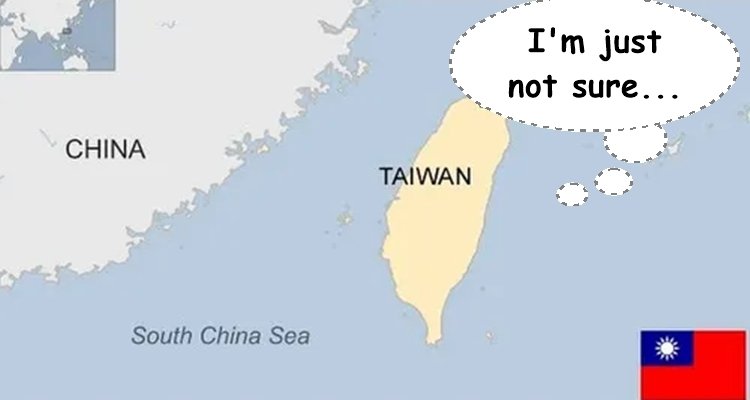
There’s no paradox. There are different political parties and perspectives. Many members of the two parties making up a majority coalition in the Legislative Yuan act as if they regard it as unimportant for Taiwan to have the strongest possible national defense in order to reduce the likelihood of an invasion from the mainland and defend itself as best it can if an invasion does come. They are opposed by members of the ruling party.
The people on one side favor appeasing the Chinese Communist Party; the people on the other side do not.
An uncertain island
The Washington Post’s editorial board says that “The global economy is relying on an island democracy’s uncertain willingness to defend itself” (“Taiwan’s self-defense paradox,” April 5, 2026). The practice of loosely describing a country as if it thinks and acts as a unit is okay for purposes of shorthand as long as we always keep in mind that it is not literally so. One may as well speak of the continental U.S. democracy’s “uncertain willingness to defend itself” because of the opposite sides that often emerge when a question of defense or of defense spending comes up.
There’s no paradox, and in the editorial itself the Post’s editors somewhat but not entirely contradict the implication that there is one.
Certainly there is a problem. The editors write:
A bipartisan group of U.S. senators recently visited Taiwan and urged the island’s lawmakers to approve a $40 billion supplementary military budget, which could help deter a Chinese invasion. Yet the country’s main opposition party is blocking the spending increase, and its leader has accepted an invitation from Chinese President Xi Jinping to visit mainland China.
This spectacle raises an unpleasant but necessary question: Should the United States guarantee Taiwan’s defense if the Taiwanese don’t take steps to defend themselves?
The self-governing democracy, which China considers a breakaway province, produces about 90 percent of the world’s most advanced computer chips. A supply disruption caused by an invasion would make the economic shock from Iran’s closure of the Strait of Hormuz look trivial. It would devastate supply chains for everything from cars and smartphones to fighter jets and GPS satellites….
Robust democracies like Taiwan naturally debate strategy. The current divide in Taiwanese politics reflects ambivalence about China and the U.S. alike….
Hong Kong had no say in its future when it was handed over to Communist China. Taiwan’s military gives it leverage and deterrence against a hostile takeover. Support from America could prove decisive in maintaining deterrence. That’s a good outcome for the world economy and a good reason for the United States to maintain the most powerful military on the planet….
But America won’t do the job alone. The Iran war shows how the United States is more likely to support highly capable partners such as Israel. If the Taiwanese don’t show seriousness about their own defense, they shouldn’t be surprised if Washington goes wobbly. The more obviously committed they are, the more credible the joint deterrent—and the more durable the peace.
The import of the current political wrangling in Taiwan is overstated. The ROC has a military, and the ruling government has taken many steps in policy and otherwise to better protect the country from the PRC.
The editorial’s conclusion is reasonable enough: the U.S. will probably be more willing to help Taiwan if Taiwan is more willing to help itself. Taiwan both is and is not. Or rather, some Taiwanese, members of the Democratic Progressive Party and its supporters, are plenty willing. Other Taiwanese, members of the Kuomintang and its supporters, are much less willing.
What about the imputed ambivalence? Some Taiwanese are doubtless ambivalent. But the Taiwanese who want to defend the Republic of China as strongly as possible from the People’s Republic of China are not ambivalent. And the Taiwanese who are most eager to pretend that the PRC is a threat only because other Taiwanese see and respond to the threat are not ambivalent either.